
Interview with Daphné Borenstein in H Magazine
Interview conducted by Raphaële de Lataillade
Daphné; she is 22 years old with long blonde hair falling over her chest, and a gentle smile that invites you into her world. She welcomes us at her parents’ place in the 15th arrondissement of Paris. Her apartment and her cats are just across the hall. We settle into a grey leather sofa that makes her galaxy sweatshirt pop, and here we go.
You’re surrounded by artists (your family comes from cinema, your brother makes music…) why did you turn to photography? That’s a good question… I started getting interested in photography when I was in high school. Since my grandfather was a photographer (a set photographer – Ed.), I had cameras in my hands from a very early age. One day, I went to see a Richard Avedon exhibition at the Jeu de Paume. It was a bit of a revelation; that was the moment I told myself “this is what I want to do,” and I started really working on photography.
What are your influences? Well, R. Avedon, that was the revelation. He’s a guy who only does portraits and fashion; I’ve always been very interested in portraiture. Beyond that, the photographers I like don’t necessarily match the style I work in. Often, there is humanity in the artists I appreciate, without them directly influencing my work. In a completely different genre, I could mention Gregory Crewdson, whom I like a lot. His work is much closer to cinema: it involves huge studio setups with entirely reconstructed sets. He always has crazy crews, and it’s precisely this cinematic, rather than photographic, approach that attracts me to him. There are also painters who influence my work a lot. Francis Bacon, for example, is one of my favorite painters; he does a lot of portraits too, and the notion of pain and suffering is very present in what he does. Egon Schiele has also influenced me a lot. His approach is a bit the same as Bacon’s (even though the aesthetics are very different). He does a lot of nudes, men or women; it’s quite violent and very raw. You also find this notion of violence, especially in his self-portraits (he was a guy who was very uncomfortable with himself). I think I have somewhat the same approach in all the work I’ve done on my body. It’s also a way to help accept oneself.
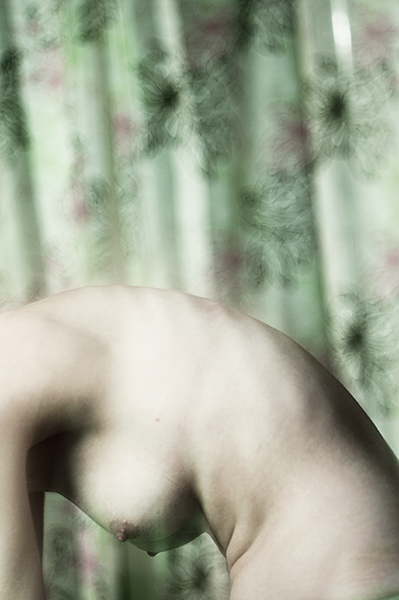
Speaking of which, I’ve noticed you do a lot of work on the body, and your own in particular. Why is that? I’ve always had a really hard time with my body. I’m very slender, and ever since I was little, I’ve often had to take comments to the face like “Are you anorexic?” or “You need to eat, you need to gain weight.” It took me a long time to accept my body. And working on it helped me a lot to accept it, because I find myself confronting it. In the Proelium series, for example, it’s pure body, without a face: I’m not trying to show the person’s identity. It’s really a study of different bodily forms, without the human element coming into play: it’s the body represented as a piece of flesh. For this series, I hurt myself, I made myself sore to get those body movements, images that are always quite tense, pulled tight, and it’s a way of expressing my inner pain in an image. In fact, the text accompanying this series explains this approach very well. I did my first works on my brother, who is also very slender, and who can make his bone structure stand out quite impressively. At the time I was very interested in the Holocaust, and I wanted to represent the bodies of the deportees (even though today I’m not very proud of using my brother for that). The approach was the same: I framed from the chest up, you never saw the head, the body was represented crudely, and in the end, it produced an image of a body that wasn’t easy to look at, by stripping away all identity. I’ve also done works where I painted my body in red and black to represent it like a piece of meat, raw flesh, with dry, cracked paint, and always this notion of pain.
Did this work you did on your body and your brother’s help you move forward, whether personally or in your art? Yes. Completely. Actually, I shot this series one night at 3 AM, at my place. But I didn’t show it to anyone. It took me more than six months to dare show it to someone, to my teachers (at Gobelins – Ed.) to get an opinion on it; because it was the first time I was showing images of my body, and I had a really hard time taking that step. The day I showed this series (it had nothing to do with what I was doing at school), it was a bit of a revelation for my teachers, because for the first time they saw genuine personal work from me. They told me there was an enormous amount of sensitivity in it. Since it was quite successful with my teachers and my friends, I ended up putting the series in my year-end portfolio, and at the Gobelins professional encounters, an agent spotted it. And since I saw that people liked it, I wanted to keep going with it, because it had always been my primary approach, the theme I cherish more than anything. So right now I’m working on another series of self-portraits, very different because this time you see my face. I pose nude, and I also find myself facing my own image, but full-length. The gaze is there and that changes everything, I’m observing myself both ways; it’s kind of the final step of acceptance, the ultimate confrontation. It also helped me in the sense that now I’m ready to move on to something else, to work on the bodies of others. For example, the other series I’ve started where I have someone pose, you don’t see the face either because what I like to work on is the body as a body, and not as an individual.
How do you work? I work almost exclusively in analog. Proelium is digital. I use digital for this kind of work for practical reasons (in analog there would be too much waste). I did this series at home, with very limited means (the backdrop is my curtains, the lighting my bedside lamp). I do a lot of tinkering when I work. I cobble things together with what I have around me. As for locations, it’s very much up to chance: while taking a walk, I find places I like, I’ll want to use the settings I discover along the way, but I’m not necessarily out looking for them. Regarding the atmospheres, it’s often quite dark and contrasted. Except for Proelium. The theme was very tough for me, and so I wanted to treat the series in a much softer way than what I normally do. Even if there’s a bit of a shock factor, because I gave the images a slightly greenish and desaturated tint (it looks almost like dead flesh), it’s also a way to represent my body in a much softer, more feminine way. Whereas normally, I don’t work like that.
On that note, I wanted to come back to this way of working in series, which isn’t necessarily easy. No, it’s quite complicated. Putting together a series takes time. Especially in digital, because you tend to shoot an awful lot. What’s very difficult is that often, we have images we like, and that we don’t want to part with, but they won’t necessarily fit into the series. Except a series isn’t just beautiful images put together, they have to work together. And that’s what is complicated. The order of the series too: what you start with, what you end with, and there needs to be an evolution in the series. There have to be moments to breathe, a climax. It’s a bit like making a film, where you have a beginning, a story unfolding, a point of conflict, and then things unraveling to reach the end. Working in a series is extra work.
Why work in a series, and not do more eclectic work? Because I find it has a lot of impact. In series, there’s a real thought process behind it (which isn’t always there in a single image). In a way, it’s also building a story, and I like that. Maybe also because it’s closer to cinema. Working in a series means working over the long term, over time. Generally, I stop working on a subject after having dug really deep into it, when I no longer feel the need to work on it. Alongside that, there are all the photos I take on the fly, in analog. They are very often portraits, and there’s a very cinematic feel to them, if only because I never frame vertically. I’m incapable of it. I only work horizontally, and just the format I use comes close to the cinematic format.
Do you have collaboration projects with other artists, with models? With models, yes, because I consider the work on my body to be pretty much finished. Consequently, I’m starting to feel the need to work on other people’s bodies. I’ve had this idea in mind for a long time. I really want to work on male bodies, because it’s a very different morphology; and also to have someone pose nude in front of me, to have the photographic gaze on the body, and not just the human gaze that stares at you, analyzes you, judges you. But finding people who agree to do that isn’t easy: I’ve had a lot of refusals. My images are quite violent, I don’t try to sublimate the body, but to show it as it is, with its imperfections, its muscles, its bone structure, and confronting this representation of your body is not easy. Because we just don’t want to see ourselves like that, simply put.
What do you think of the hype? I think that despite myself I fit into that wave a bit… But I have a really hard time with the people who are part of it, because there’s a somewhat elitist side (“I want to know everything before everyone else”), and then the image side of it. Then again, it’s like with any trend, it’s fitting into a movement, matching a type of image, and including yourself in a group; and I find that a bit of a shame. Besides, I change my style every 6 months. For example, last year I dressed in fifties style.

